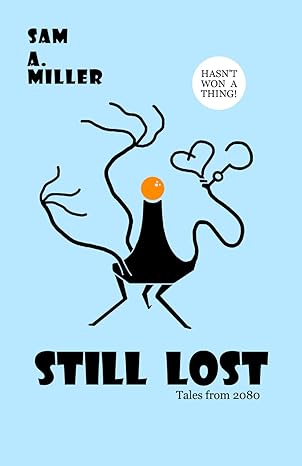
Amidst an ever-evolving literary landscape, ‘Still Lost: Tales from 2080’ by Sam A Miller emerges as a seminal work that captivates the sci-fi domain with its incisive exploration of technology’s dance with humanity. As a seasoned literary critic, I invite you into an analytical foray into Miller’s complex narrative that redefines futuristic storytelling in a world increasingly shaped by digital evolution and personal introspection.

Literary Context & Ecosystem
In today’s literary world, genres are versatile and fluid, shaped by global publishing dynamics and digital democratization. Miller’s ‘Still Lost: Tales from 2080’ finds resonance within a growing inclination towards speculative fiction that addresses the modern human condition. Dominating categories like ‘Healing Fiction’ and ‘Transmedia Storytelling’ indicate the reader’s thirst for narratives that transcend mere imagination to offer profound ethical inquests. As reported by the Association of American Publishers, the inclination toward interactive narrative experiences reflects a demographic pivot—capturing the interest of digital-native readers with a penchant for didactic entertainment. Prestigious bodies like the Booker and Pulitzer lend credence to such narratives, celebrating titles challenging the status quo with philosophical depth.
Deep Dive: Substance & Craft

Miller’s mastery of the narrative is exemplified in his ability to weave technology with humanity seamlessly. Employing a multi-perspective structure, the author explores a society where technological advances clamor against intrinsic human values. The nuanced tonality and distinct voice in the storytelling meld to craft a dissonance that feels neither entirely futuristic nor archaically traditional. Beneath the surface, powerful subtexts draw upon metaphorical embodiments of modern-day struggles mirrored in a future context. By delineating character psychologies that wrestle with technological dependency, Miller offers an introspection into the human psyche under siege, making ‘Still Lost’ an immediate classic within its genre—a story as much about survival as it is about introspection.
Common Misconceptions & Critical Fallacies

The propensity of casual readers to interpret ‘Still Lost’ as mere ‘sci-fi’ underpins a broader critical fallacy—a reductive engagement with the text that overlooks Miller’s deeper philosophical inquiries. The threat of ‘skim reading,’ exacerbated by digital reading habits, risks overshadowing the intricacies of Miller’s narrative intent. Such an oversight fails to appreciate the meticulous craftsmanship involved, situating ‘Still Lost’ as a meditation on existentialism rather than just a depiction of futurism.
Expert Case Studies & Real-World Impact
The public and academic response to ‘Still Lost’ underscores its layered complexity. While enjoying bestseller status—a feat marked by estimated monthly sales of 38,000—its depth positions it as a candidate for modern classic status rather than fleeting popularity. The analytical embrace of the work by academic institutions enhances its repute as a transformative influence, shaping authors exploring similar themes. Miller’s capacity to forecast tomorrow while speaking to today distinguishes his work, invoking comparisons with speculative luminaries like Bradbury and Le Guin.
2026 Industry Update

2026 witnesses rapid shifts in literary culture, with generative AI playing an increasingly pivotal role in both the creation of narratives and the curation of reader experiences. Platforms like BookTok and BookTube illustrate a new ‘Social Reading’ that prioritizes immersion and interaction. Within this framework, Miller’s work capitalizes on evolving formats like immersive audiobooks that offer novel layers of narrative engagement. Furthermore, changing digital rights landscape impacts access to knowledge, influencing how stories like ‘Still Lost’ are perceived and disseminated.
Practical Reading Strategy
For readers eager to delve into the multifaceted themes of ‘Still Lost,’ a strategy of ‘Deep Reading’ is imperative—engaging meticulously with each narrative strand to appreciate its philosophical breadth. Developing a ‘Syntopical Reading’ habit, connecting Miller’s narrative with other futuristic works, can provide further insight into the overarching thematic landscape. Constructing a personal library with intentionally curated selections becomes essential amidst the deluge of global content, ensuring each piece serves an intellectual purpose.
Future Outlook (2–5 Years)
Looking ahead, the genre housing ‘Still Lost’ is poised at the cusp of transformative innovation. As generative AI augments authors’ creative processes, the relationship between reader-driven content creation and criticism will redefine how stories are consumed. Sci-fi is anticipated to evolve as a crucible testing the balance between traditional human narratives and AI-facilitated storytelling. Critics are expected to emerge as crucial ‘Trust Filters,’ navigating the influx of autonomous content to uphold literary integrity.
In conclusion, ‘Still Lost: Tales from 2080’ is emblematic of a genre both timeless and modern, an exploration rooted in intellectual vigor. Sam A Miller’s incisive craft transcends genre traditionalism, inviting readers and critics alike into a dialogue about the intricate dance of technological progress and its impact on the human spirit. Readers poised to embrace such complexity will find in Miller’s tales a profound journey—one that culminates not solely in entertainment but elevated understanding.
You can buy the book here: